Startup founder and board & C-suite advisor helping teams use AI to cut supply chain risk and boost sustainability. Practical playbooks for culture change and measurable ROI.
If you’re a US manufacturer who breathed a sigh of relief over federal climate rollbacks, you’re currently standing in the centre of a strategic pincer movement — and you may not have noticed yet.
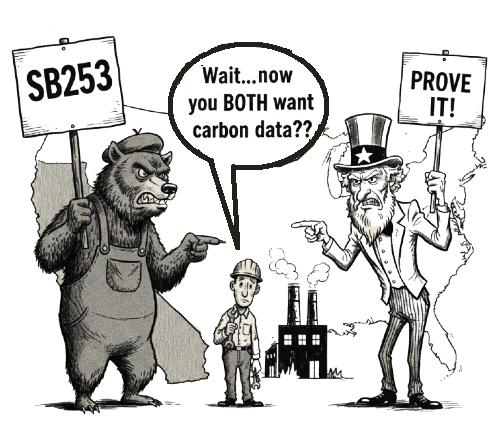
While the “hardware” of international climate treaties is being dismantled in Washington, the “software” of global economic reality is tightening its grip from two directions at once. One jaw is closing from the left coast. The other from the capital itself.
The Left Jaw: California’s SB 253
The California Air Resources Board is moving forward with SB 253 — the Climate Corporate Data Accountability Act. Under this law, any company doing business in California with over $1 billion in annual revenue must publicly disclose their Scope 1, 2, and 3 emissions.
Here’s the supply chain implication that most manufacturers are missing: almost every major US enterprise — your customers — does business in California. That means their Sustainability Officers are now legally required to demand your emissions data. Not as a favour, not as a preference. As a condition of their own regulatory compliance.
Your Scope 3 numbers aren’t optional anymore. They’re your customers’ legal obligation to collect.
The Right Jaw: The PROVE IT Act
The Producing Responsible and Optimal Energy for Industry and Technology Act — the PROVE IT Act — has cleared the Senate with bipartisan support and been weaponised by the US Department of Energy as a trade instrument.
The logic is straightforward: the DOE is benchmarking the carbon intensity of US industrial production versus foreign competitors. The intent is to give US procurement officers a federal standard for preferring “competitively clean” domestic suppliers over high-risk foreign ones.
This isn’t a moral mandate. It’s a trade shield dressed up in sustainability language. Your Procurement customers won’t be selecting you because you’re virtuous — they’ll be selecting you because you’re defensible. And “defensible” now requires verified emissions data.
The Compliance side wants your data for the lawyers. The Competitiveness side wants your data for the sales team.
What This Means for Your Supply Chain
The era of “don’t ask, don’t tell” carbon accounting is over — not because the federal government mandated it, but because the market infrastructure around it has hardened in ways that can’t be rolled back by executive order.
The practical implications for manufacturers are sharp:
Your biggest customers are already exposed. If they operate in California, they need your numbers. If they can’t get them from you, they’ll find a supplier who can provide them — or they’ll estimate your footprint unfavourably and price in the risk.
The PROVE IT Act creates a new selection criterion. Federal procurement benchmarks don’t disappear when administrations change. The data infrastructure being built now will outlast the political cycle that created it.
Credible data is the new hard power. As I noted in my recent analysis of the 2026 SDG performance rankings: raw force is a terrible long-term investment. The compound interest of consistent, verifiable data beats the brute force of regulatory avoidance every time.
The rollback isn’t coming for the markets that matter. The question isn’t whether to prepare — it’s how quickly you can turn your emissions data from a liability into a competitive asset.
“One day the country could have a digital minister and even an AI prime minister” Edi Rama, Prime Minister of Albania
Albania just made history. It has appointed Diella, an AI‐created virtual minister, to oversee public procurement, a sector that has allegedly been long-accused of corruption and inefficiency.
What are the implications for procurement professionals, and how might this model spread to other bureaucratic roles?
What Diella tells us about procurement’s future
Objectivity & Transparency as Competitive Advantage – By shifting tender evaluations to AI, Albania aims to remove human bias, graft, and conflict of interest. For procurement professionals, this raises the bar: transparency isn’t optional. The value of clean data, well‐documented process, auditability will increasingly define who wins or loses — whether in government or private sector contracts.
Human Oversight Still Is, or Must Be, Critical – Diella isn’t (publicly at least) fully autonomous: questions remain about oversight, manipulation, legal liability. For procurement leaders, the takeaway is that AI can handle many procedural tasks, but designing how humans remain in the loop, how biases in training data are addressed, how exceptions are managed will be key responsibilities.
Procurement Becomes More Data‐Centric and Technical – Tender evaluation, risk scoring, supplier vetting, contract compliance — these will increasingly rely on algorithms, metrics, dashboards. Procurement professionals will need more fluency in data science, AI governance, process engineering. The role shifts away from paper chasing & negotiation toward strategy, oversight, and design of AI‐mediated systems.
Ethics, Trust & Reputation as Core Capabilities – The biggest risk may not be a technical failure, but rather, a loss of public trust. If an AI “minister” makes decisions that seem opaque, unfair, or wrong, the blowback could be severe. Procurement pros who build systems must embed ethical guardrails, fairness, explainability in their processes.
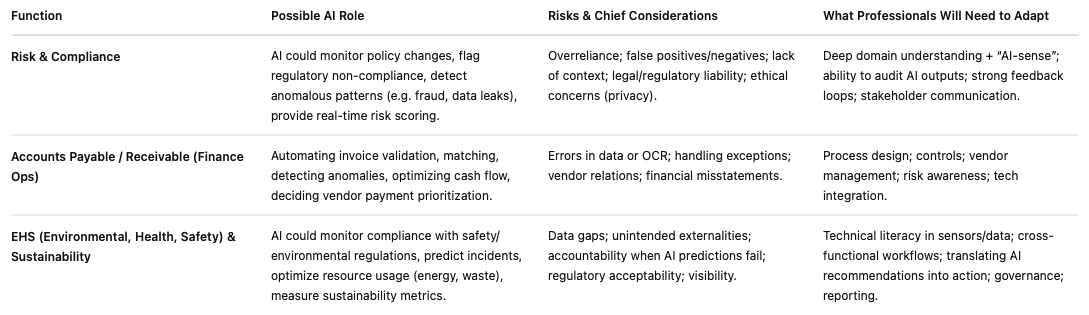
Extrapolating into Other Bureaucratic Roles
How this paradigm might map onto other functions.
What This Means for Procurement Professionals Right Now
Start experimenting with small, auditable, rule-based AI systems in your workflows (vendor scoring, supplier risk, contract compliance) so you understand strengths & pitfalls.
Build or sharpen skills in AI governance: fairness, explainability, bias mitigation.
Push for transparency: traceable decision logs, ability to contest AI decisions.
Engage legal/regulatory teams early: what are the boundaries of delegating authority to AI? What is the liability?
Cultivate stakeholder trust: employees, suppliers, customers all need to understand the “why” and “how” of AI decisions. Clear communication + good code.
Final Thought
Diella shows that traditionally slow-to-move organizations, like governments, are willing to hand over complex, rules-based processes to machines. The real work for professionals is deciding how much trust to place in those systems, and where human judgment still needs to apply.
For procurement professionals, that signal should stir both alarm and opportunity. Alarm, because the rules of procurement are being rewritten. Opportunity, because those who master these emerging rules — governance, transparency, data ethics, human-in-the-loop oversight — will set the standard.
For EHS and sustainability professionals, the opportunity is even larger. These are fields where data quality and reporting accuracy can mean the difference between regulatory approval or penalty, safe operations or an accident, credibility or greenwashing.
As AI takes on roles once thought uniquely human, our value will lie less in simply “doing our job” and more in ensuring that when AI does it, it does it better.
About the Author:
Daniel Perry is a Silicon Valley-based start-up founder — and advisor to investors, boards & CEOs — connecting sustainability, technology & impact.
This is a repost from November 28, 2017. Original article available here.
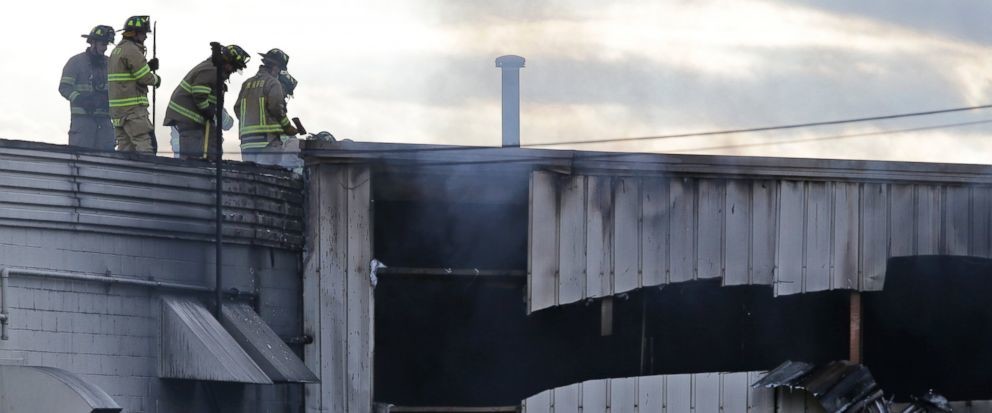
On November 20, 2017, New Windsor authorities say two explosions and a fire at a contract manufacturer in the Hudson Valley about an hour north of New York City left multiple people injured, including firefighters caught in the second blast. As of November 21, the tally was one man dead and 125 hurt after the deadly explosions.
Working in the sustainable procurement field, I try not to focus too heavily on sharing these horror stories. In fact, one of my favourite supplier sustainability stories revolves around another New York state contract manufacturer in the consumer goods space that avoided any such catastrophe, going from “Zero to Hero” in terms of their Environmental Health and Safety in a few short years. As I write this post from my company’s New York office, however, the avoidability of this tragedy and needless loss of life strikes frustratingly close to home and I feel compelled to share my views on this horrific disaster. When I first heard of this event, the questions that sprung to mind were:
1) Were any of the Supplier’s B2B customers aware of the level of risk to the factory workers?
2) If not, why not?
3) If so, why didn’t they act?
This event was brought to my attention because the company I work for, EcoVadis, provides corporate social responsibility ratings and monitoring of legal entities (most often ‘Suppliers’) on their environmental, social, ethics and supply-chain performance. In other words, EcoVadis could have picked up some of this particular plant’s gaps in management systems, or at bare minimum, the supplier’s 19 OSHA violations, had a client requested it.
“This tragedy could have been avoided, if only one of their B2B customers had used EcoVadis…”
Upon learning of the explosion and resulting fire, my first instinct was to share a quick one sentence post or tweet, with a link to the article, saying something like, “This tragedy could have been avoided, if only one of their B2B customers had used EcoVadis…”, but an opportunistic plug for my employer would have been missing the point entirely… Assessments don’t save lives, action does… While an EcoVadis assessment could have told the Supplier (and their B2B customer) what the problems were and what the Supplier could have done to improve, in the case of this particular Supplier, they were already well aware of what the problems were (19 OSHA violations and fines of totalling $60,421 are a testament to this). Ultimately the risk/reward was such that, for whatever reason, the Supplier chose not to act. Saving lives requires action, and if there was anyone who could have saved lives in this scenario, it was their B2B customers. $60k in fines may not have moved the needle with this Supplier, but I bet millions of dollars in potential lost revenue could have.
So where is Procurement in this tragedy? Did they have the resources at their disposal to drive tangible improvement in working conditions and yet choose not to use them? What would have been Procurement’s motivation to look into this supplier in the first place? We may never know. By now their customers have likely already hit the ‘panic button’, scrambled to find an alternate/interim supplier, cut their losses and moved on. Perhaps the Supplier’s B2B customers had the resources to drive improvements, but chose instead to focus their attention on other suppliers perceived to be of higher risk…
companies take responsible sourcing seriously – but only in developing countries
As more and more production is moved offshore to countries like China, the focus of supplier vetting and due diligence tends to be offshored as well. Scandals involving product quality, environmental impacts, and modern slavery ensure companies take responsible sourcing seriously – but only in developing countries. In North America, it seems, the law of the land is seen as ample protection from supply-chain disruption, and as such, North American suppliers are being treated as ‘low-risk’, which ultimately leaves them off the hook in global responsible sourcing programs.
“There are good suppliers in ‘risky’ countries and risky suppliers in ‘good’ countries”
As cases like this highlight, however, assuming North American suppliers are “safe” and Chinese suppliers are ‘risky’ is not a sustainable long-term approach. As a Responsible Sourcing professional once told me, “There are good suppliers in ‘risky’ countries and risky suppliers in ‘good’ countries”. In other words, a supplier’s factory’s geographic location is not a proxy for risk. Due diligence must be undertaken by procurement with all suppliers on an ongoing basis – regardless of geographic location – and those suppliers need to know that buyers truly care about the safety of factory workers and want to see their continuous improvement!
Care (and duty thereof) is the key here, because to mitigate the likelihood of avoidable disasters and tangibly improve the environmental health and safety of workers, it’s going to require that CPOs genuinely care about their Suppliers’ CSR & Sustainability on the front-end (not after-the-fact), and stop treating it like a ‘check the box’ exercise for geographically ‘at-risk’ suppliers.
In Summary
This tragedy was avoidable.
CPOs need to take ‘responsible sourcing’ and ‘sustainable supply-chain’ initiatives seriously and globally (and ‘globally’ includes North America).
Category Managers must put non-financial performance as the first KPI on the list (above Cost, Quality, and On-Time Delivery).
Sourcing Directors must include Corporate Social Responsibility in RFPs and ensure suppliers are incentivized to improve on an ongoing basis.
As US Federal regulations drop like Fall leaves, it’s up to Procurement to fill the due diligence void left behind by motivating suppliers to maintain the highest of standards, benchmarking their suppliers against global best practice, and rewarding those suppliers that go ‘beyond-compliance’. Corporate-led multi-stakeholder industry initiatives may also help (such as the Responsible Beauty Initiative that launched in November 14, 2017). While due diligence with suppliers in emerging markets will always be a necessity, it should never be at the expense of the wellbeing of workers and their families in the buyer’s backyard.
This is a repost from August 14, 2017. Original article can be found here.
I was honored to have the opportunity to speak at the United Nations Headquarters recently. To be invited into the hallowed halls of the UN, walking past portraits of global leaders and heroes, you get a sense of the seriousness of the institution and the gravity of what is at stake.
Inside what seemed like a “War Room“, with business, government and non-government organizations well represented, the tone was at times fittingly combative.
The day kicked-off with an (unintentionally intense) introduction from Nikhil Seth Executive Director of UNITAR and Paloma Duran Director of the SDG Fund. After cordially introducing the day’s events, the floor was open for a few questions from the attendees, (typically reserved for obligatory house-keeping questions, or a few soft open-ended questions about the state of “international progress”). The invitation for questions resulted in a European government representative challenging the sustainability (and therefore integrity) of the intergovernmental organization’s funding sources, leaving the panelists to calmly refer the attendee to anecdotal evidence of the vetting process for accepting funds from corporations. Good to know, but not exactly the “we can do this” kind of attendee engagement anyone was expecting.
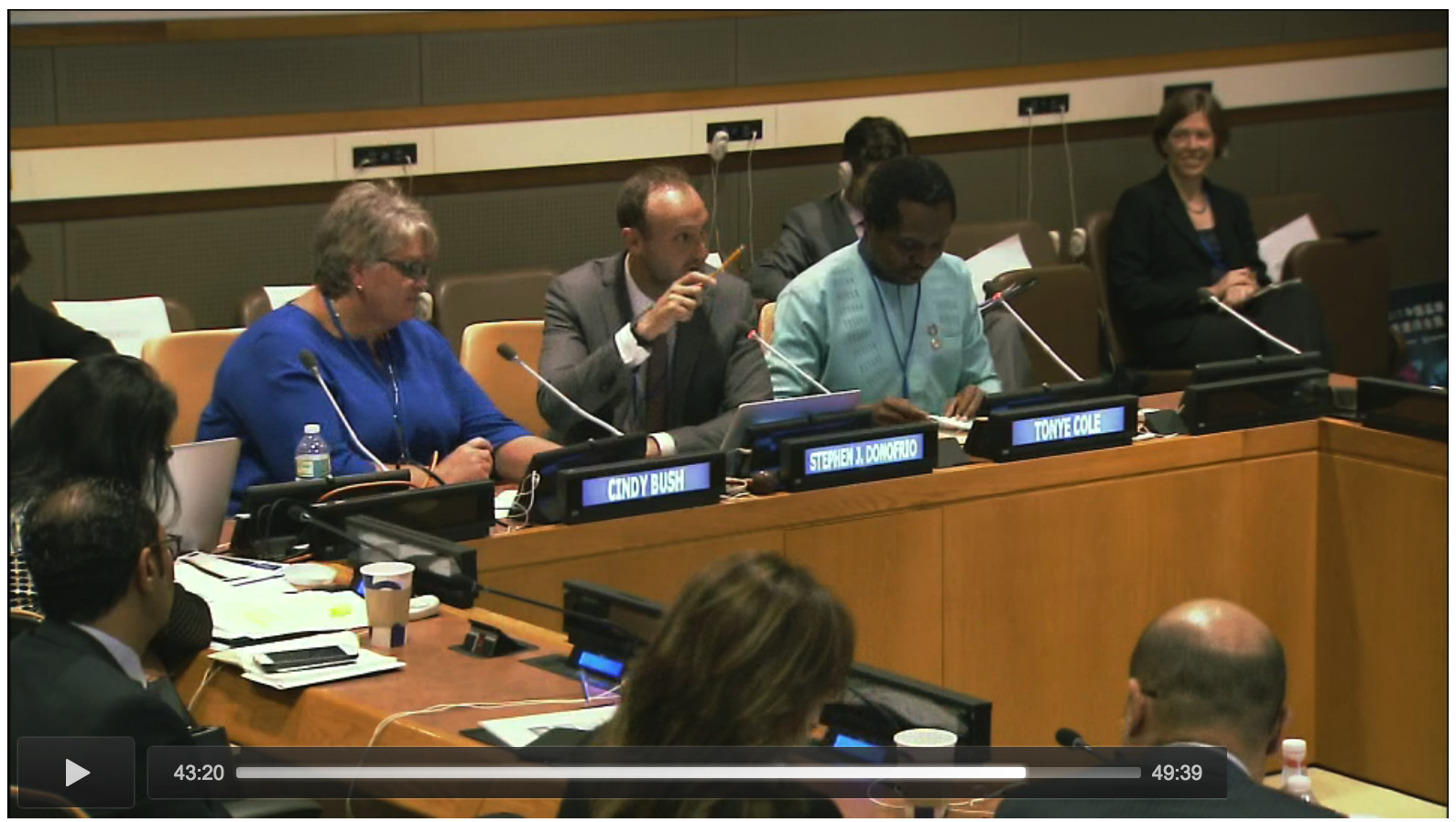
The moderator for the second session, Stephen J. DonofrioSenior Advisor for Supply Change atForest Trends Initiative, promised a more interactive session featuring suppliers discussing “how to initiate and sustain internal processes and initiatives”. The panel featured two distinctly different perspectives, with Tonye ColeCEO of the Sahara Group, a large Nigerian private energy company, and Cindy Bush Director of Environmental Health and Safety and Sustainability at Tessy Plastics Corporation, a family owned and operated contract manufacturer headquartered in central New York.
Mid-way through the presentation, it was apparent that doing business in both the energy and the plastics sectors are inherently challenging, with some attendees wasting no time shedding light on some of those challenges – asking how the panelists intend to tackle regional social issues, what they are doing to drive eco-friendly initiatives and how they navigate volatile political climates while maintaining corporate and social integrity.
While Donofrio was able to calmly collate the various (and sometimes lengthy) questions into succinct inquiries that Tonye Cole and Cindy Bush could deftly navigate, it started to seem like the attendees may be left with more questions than answers, and the task of figuring out how businesses can save the world from environmental and social disaster, was at best looking elusive.
Then somewhere near the end of the session, Cindy Bush answered a question which inadvertently provided a master-class in storytelling, while allowing the attendees the opportunity to pivot from “Us & Them” to simply “Us”.
Cindy was asked to comment on a major barrier to businesses leading the way: Large companies are often hesitant to roll-out supply chain sustainability programs because they think small suppliers are either unprepared or unwilling to participate.
“… I really didn’t know what I was doing five years ago… But, failing their survey was one of best things to EVER happen to our company.” – Cindy Bush, Tessy Plastics
What are we talking about?
Cindy started by clearing the air and explaining the topic, “sustainable procurement”, and what it means, as it relates to her customers, “…We’re a tier one supplier for large OEMs, and they have some requirements for their suppliers, (and they articulate them quite well), and our duty, as a supplier, is to try to figure out how to take their aspirations, and put them into practical day-to-day operations and actions.”
Then she clarified what sustainable procurement means in the context of her own supply base, “… because we know what is required and what our customers are asking of us… one of the key things that we’ve learned… is how to take take what’s been required of us, and then turn around and “softly” require it of others… “
Make it Personal
With the topic crystal-clear to everyone, Cindy humanized the challenge faced by many organizations, dispelling any potential cynicism toward her sincerity, by sharing an unguarded moment: “[J&J] gave us the EcoVadis assessment and survey, which has served as a guide-post for the development of our program… I actually find myself getting choked up when I think about it because… I really didn’t know what I was doing five years ago. I told you the truth right? But failing their survey was one of best things to EVER happen to our company.”
Back it up with Data
Many speakers before and after had fantastic data, and solid business cases, but the reason Cindy was so persuasive is that she kept the data in her pocket until the audience was ready. Only once the attendees were fully-engaged, did Cindy hit them with the hard facts. Explaining why failing the assessment was the best thing to ever happen to her company, she continued, “… and here’s how I know it to be true. [At] the same time that we did not do well on our first EcoVadis score, we were only 300,000 square feet, we barely had 400 employees and profit sharing in a quarter was fifty dollars.”
“[Five years on,] now we’re 1.5 million square feet, we deal with some of the largest OEMs in the world, and we have tripled, (if not more), our profitability. All [while] at the same time, (which is not lost on all of you), we kept our eye on the prize – We got real about our responsibilities, we understood how to make and have less impact on the environment, the world, and have a positive impact on our employees.”
The Result
Cindy’s response blew everyone away – In a few short minutes she managed to eloquently demonstrate the important role her customer, Johnson & Johnson, played by inviting Tessy Plastics to participate in a Sustainability Rating program, the significant business benefits Tessy received by participating, the correlation between sustainability and profitability, and the positive flow-on effects corporate social responsibility can have when applied to the context of a multi-tier supply chain.
Cindy’s response was authentic, engaging, and relatable, but it also had the unintended effect of refocusing and uniting the attendees. There was a palpable enthusiasm and freedom to be authentic, which gave attendees and panelists liberty to openly communicate on challenges and successes alike.
In the space of one session, (and arguably the length of one story), the atmosphere had transformed from a combative collective of competing interests, to that of a collaborative group of diverse stakeholders ready to tackle the world’s biggest challenges.
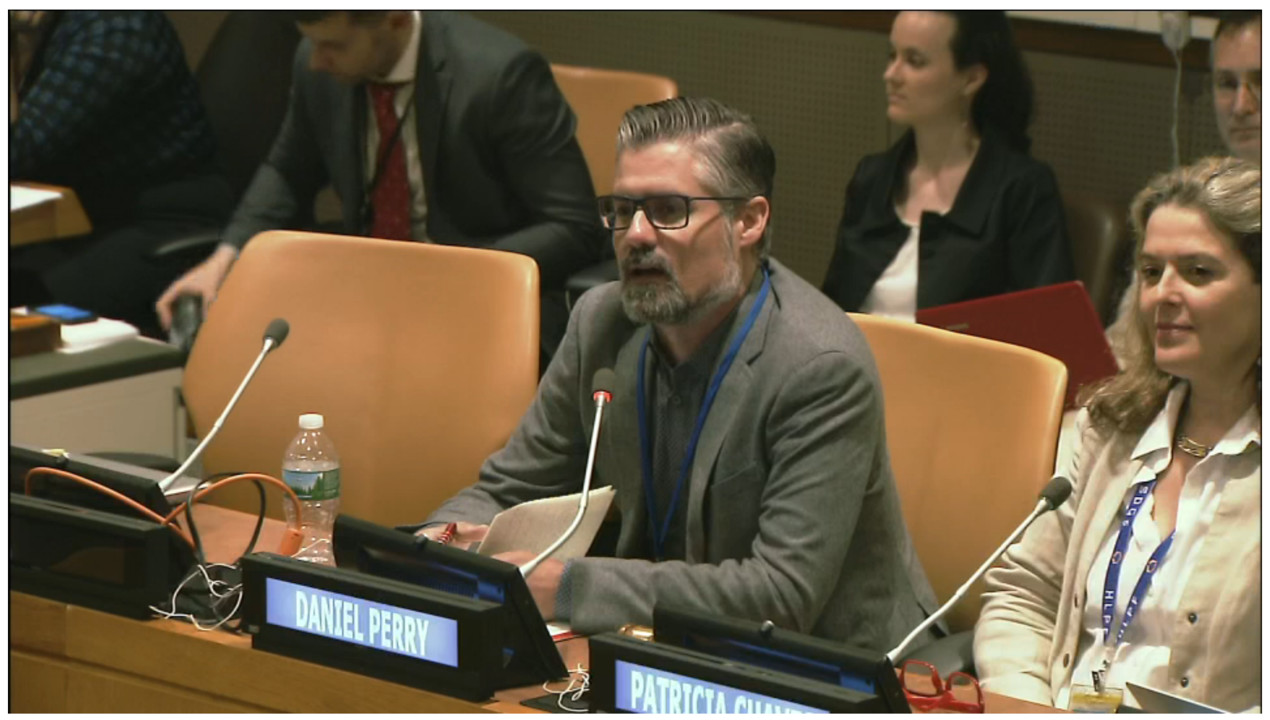
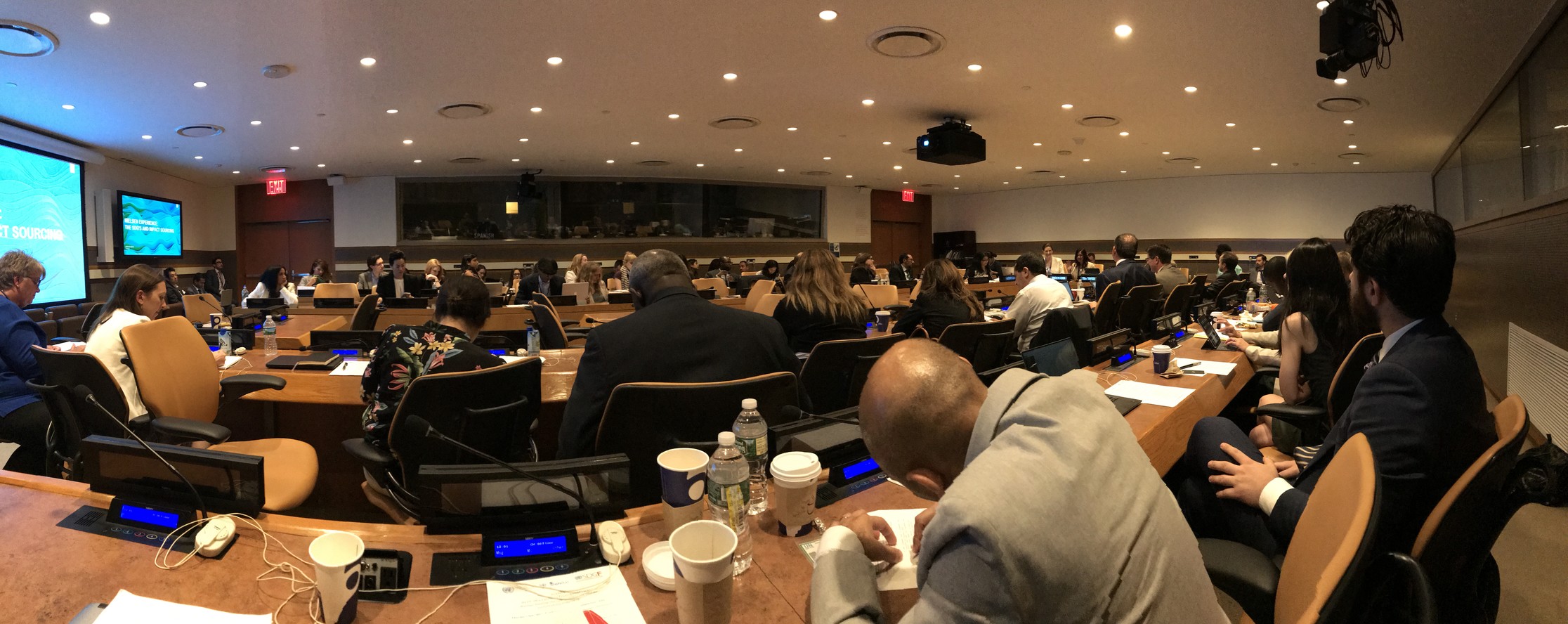
(My view during Training Session 3 SDGs and the role of the Supply Chain)
By the time I was called upon to introduce the “Closing – Inspirational Recap” speakers, Evan Harvey Global Head of Sustainability at NASDAQ,Patricia Chaves Senior Sustainable Development Officer at the United Nations Division for Sustainable Development (UNDESA), and myself, it was almost impossible to bring order to the group, as they were (dare I say) having too much “fun”. Maybe that’s a stretch, but there was definitely “collective excitement”, with attendees sharing ideas with their newly acquainted peers. Certainly not a bad level of engagement for 6PM on a weekday, after spending an entire day locked in a bunker.
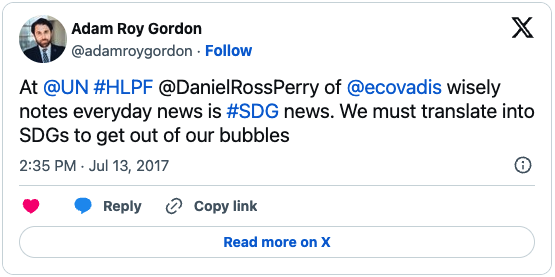
The wrap-up session provided Evan Harvey an opportunity to show why he is a sought-after sustainability thought leader, effortlessly relaying relatable case studies of SDG-inspired sustainability success. Patricia Chaves took the opportunity to challenge the attendees to take the SDGs back to their workplace, stay engaged throughout the coming 12 months, and return with stories of progress. Finally, I challenged the attendees to be “translators” of the SDGs, and was happy to provide an answer to the last tricky question of the day, as it gave me an opportunity to talk about a topic I care about a great deal.
All told, I found this to be a truly inspiring event, thanks in no small part to the story relayed by Cindy Bush, which set off a chain reaction of compelling discussion (that we’ll all be striving to ensure leads to progressive action).
This is a re-post. Original post from July 8, 2015 can be found here.
Long Island, NY, July 7, 2015 —Suffolk County Community College, the largest community college in the SUNY (State University of New York) system and Unimarket, an innovator in e-procurement and spend management solutions for higher education, have signed an agreement to implement Unimarket’s full suite of solutions, with integration to Suffolk’s ‘Banner by Ellucian’ finance system. Suffolk County Community College has selected Unimarket to provide their full suite of solutions, including e-Marketplace, e-Procurement Workflow, e-Invoicing, Supplier Registration, e-Sourcing and Contract Management.
Suffolk CCC President Dr. Shaun McKay says,
“The College is looking forward to the efficiencies of Unimarket’s e-Procurement solution. We expect a substantial change to our current procurement practices with special focus on streamlining our processes, expediting transactions, assisting with contract management and providing stronger visibility, reporting and compliance.”
– Dr. Shaun McKay, President at Suffolk County Community College
Peter Kane, Chief Executive Officer of Unimarket commented,
“We are delighted to add Suffolk CCC as our second SUNY college alongside Nassau Community College. This reinforces our continued commitment to provide comprehensive and affordable solutions to public colleges and Universities in the state of New York and across the country. We look forward to demonstrating the value that a fully integrated suite of procurement solutions on a single, easy-to-use platform can bring.”
– Peter Kane, CEO at Unimarket
The Unimarket eProcurement solution implementation will commence immediately and will leverage Unimarket’s unique community source Banner integration. The solution is expected to launch campus-wide by November 2015.
Unimarket was formed in 2005 to deliver collaborative electronic procurement solutions for businesses using the latest technology to enable them to easily connect and transact with their suppliers in a single portal to save costs, improve efficiency, and reduce paperwork. The hallmarks of Unimarket’s solution are ease-of-use and an open-market philosophy of unlimited users and unlimited supplier connections delivered in a cost-effective manner.
Why isn’t everyone as excited as you about “savings”? And how do you prove how much you actually save?
This is a re-post. Original post can be found here.
I recently connected with Prof. Samuel D. Bornstein on LinkedIn and I’ve been following his summaries of nationwide government Strategic Sourcing initiatives with great interest. One in particular caught my attention, where it seemed that the state of Pennsylvania’s strategic sourcing savings were based on “cost avoidance” rather than actual measurable unit price savings. At first glance it’s easy right-off “cost avoidance” as not being true “savings”.
A real life example might be if I decided not to buy a $1000 suit. Have I just saved $1,000 in cost avoidance? Maybe not… What if I don’t need a new suit right now, but I find one on sale for $800. Am I therefore achieving unit price savings of $200 if I buy the suit just in case? These scenarios highlight why measuring savings can be trickier than you would think…
Moving from a purchasing policy of “just in case”, to “just in time” can help organizations spend less and help avoid unnecessary purchasing. When it comes time to audit the success of the purchasing policy though, it can sometimes be difficult to accurately frame the “savings”, particularly if your audience’s perception of savings is tied to unit price. Ultimately government departments will spend their budget whether or not they avoid unnecessary purchases, or purchase goods at lower prices. Where quantifiable savings can be made is in the process rather than simply driving the unit cost down.
As an example, let’s say I need a new desk chair, and after searching the internet and calling local vendors, I found a way to save my organization $50 on the desk chair I need. I can even save on shipping, if I drive the company vehicle across town to purchase the chair. When I get there, I find they have four chairs available at the special price, so I purchase all four (just in case someone else might need a new chair a a later date). Now I’ve saved the organization $200! Then I return to the office, submit the receipt/invoice to accounts payable to process a reimbursement/payment, which then routes to my manager for approval, and eventually a check is cut.
In this scenario, I have achieved lower prices for these goods, so by definition, I have just saved the organization $200, right? Not so fast… More likely I’ve just cost the organization well over $200 by incurring mileage and fuel cost on the company vehicle, plus I’ve spent half my day researching the chairs and driving across town. In addition I’ve taken multiple employees away from their day-to-day jobs, thus reducing their productivity and costing the organization at least a day’s time and materials. Plus, I now have three extra chairs gathering dust, taking up valuable storage space, that may never be used. Finally, the vendor is probably not on contract, so that opens up my organization to other potential risks down the line. While the process is certainly not optimal (approval after the fact), this practice of buying more than is immediately required is typically defined as “just in case” purchasing. This is likely what the State of Pennsylvania were talking about when they said, “avoiding unnecessary purchases is a cost saving”.
So let’s say my organization implements a new purchasing policy, backed by an automated system, that prevented these types of “just in case” purchases from happening. Now any purchasing of furniture is quick, easy, on-contract and in adherence to policy. Would we then be able to prove serious cost avoidance savings? Maybe… but we would still have a hard time convincing the average Joe. Trying to prove those savings gets muddy really quickly, and this is why it seems obvious to blame a screwed analyst when the numbers seem to good to be true. To prove these types of savings, you can end up wasting a lot of time and energy trying to define what “could have” happened, and what the purchasing process “might have” cost. Trying to calculate savings based on those variables could ultimately lead to an argument about the definition of “savings”, rather than discussing whether or not the new purchasing policy/process is a success.
Ultimately a lot of organizations (public and private) have antiquated purchasing policies (focused on control) and labor intensive purchasing processes (focused on auditablity). Procurement/sourcing professionals need to be incentivized to remedy these resource-draining issues, rather than be constantly measured on unit cost savings alone. In other words, why grade them on how well they can negotiate the cost of paper, if they can help your organization go “paper-less”?
This is a re-post. Original post from January 12, 2015 can be found here.
Roswell, NM, January 12, 2015 —New Mexico Military Institute (NMMI), a state-supported military junior college, and Unimarket, an innovator in spend management solutions for higher education, have signed an agreement to implement full eProcurement and eInvoicing automation with integration to NMMI’s Microsoft Dynamics Great Plains finance system.
NMMI conducted a thorough search and selection process evaluating the features and benefits of the leading eProcurement providers and chose Unimarket as the one provider that meets all of their comprehensive requirements, including functionality, flexibility and cost.
COL Judy Scharmer, Chief Financial Officer at NMMI, says,
“One of NMMI’s strategic objectives is to employ the best available technologies to enhance sound fiscal policies and support the efficient use of personnel time. We think Unimarket’s eProcurement system is a significant step into NMMI achieving that objective. NMMI is excited about moving out of our antiquated time intensive paper process. Our users have been asking for an electronic solution for some time now and we finally found it with Unimarket.”
– COL Judy Scharmer, CFO at NMMI
Peter Kane, Chief Executive Officer of Unimarket commented,
“Unimarket is pleased to add New Mexico Military Institute as our first customer in New Mexico, reinforcing our continued national growth. This was a competitive and thorough, cross-campus process and we are delighted that once again a unanimous decision was underpinned by end-users preferring Unimarket as more user-friendly. The Unimarket solution has been built from the outset with ease-of-use as a key design element, as we firmly believe this drives adoption, which in turn drives value for the institution.”
– Peter Kane, CEO at Unimarket
The Unimarket eProcurement solution implementation will commence within the coming weeks and is expected to launch campus-wide by April 2015.
New Mexico Military Institute (NMMI) is a state-supported educational institution located in Roswell, New Mexico, United States. Known as “The West Point of the West,” NMMI remains the only state-supported co-educational college preparatory high school and junior college in the United States. Serving the educational needs of an international student population, the Institute has strict admissions standards that yearly result in an enrollment of approximately 1,000 students who come from 43 states, the District of Columbia, and 13 foreign nations.
NMMI grants High School diplomas and Associate of Arts and Associate of Science degrees. The Institute’s emphasis on qualities of honor, integrity, and responsibility, contributes to its unique educational philosophy.
Unimarket was formed in 2005 to deliver collaborative electronic procurement solutions for businesses using the latest technology to enable them to easily connect and transact with their suppliers in a single portal to save costs, improve efficiency, and reduce paperwork. The solution uses a multi-tenant architecture and is provided on a Software-as-a-Service (SaaS) business model.
The hallmarks of Unimarket’s solution are ease-of-use and an open-market philosophy of unlimited users and unlimited supplier connections delivered in a cost-effective manner. Having great technology is just the enabler so Unimarket takes a unique partnership approach with all their customers to ensure they get the most from their product on an on-going basis, including proactive assistance with supplier enablement, organizational rollout, best practice process improvements, and more.
This is a re-post. Original post from December 12, 2014 can be found here.
Ithaca, NY, December 12, 2014 — Ithaca College, one of the top private Liberal Arts Colleges in the country, and Unimarket, an innovator in spend management solutions, have signed an agreement to implement Unimarket’s e-Procurement full suite of modules (including e-Invoicing, e-Sourcing, Contract Management and Supplier Registration), with integration via Unimarket’s Connector middleware to Ithaca’s R12 Oracle E-Business Suite Financials.
Rigorous and competitive bidding process
Bryan Roberts, Associate Dean at the Roy H. Park School of Communications, and Chair of the Information Technology Committee, explains,
“A critical component of our Strategic Sourcing Initiative has been the research, review and selection of an e-Marketplace provider.”
“After a rigorous and competitive bidding process, one which garnered participation from a large cross-section of the campus community, I am very pleased that Ithaca College has engaged with Unimarket to provide our first e-marketplace solution.”
“Already serving institutions such as Creighton University and University of New Hampshire, Unimarket’s “Amazon.com-like” electronic online marketplace will provide an intuitive and user-friendly shopping experience for faculty and staff. Leveraging our current spending habits, Unimarket’s e-marketplace will allow the campus to obtain contract pricing for products from the College’s preferred suppliers while cutting down on the costs associated with procurement card usage.”
– Bryan Roberts, Associate Dean at Ithaca College
Customer endorsements invaluable
Peter Kane, CEO of Unimarket adds,
“Unimarket is delighted to add Ithaca College to our growing list of New York State customers. While we had no interaction with Ithaca prior to the RFP, coming out the other end with an agreement in place I think speaks volumes, not only about Unimarket’s comprehensive solutions, reputation in the marketplace and experience, but also about Ithaca’s thorough process, particularly, the importance they placed on staff and faculty involvement.”
“As with any award, we are conscious that a key aspect of the selection process is the customer references. We have a very collaborative customer-base, and we sincerely thank our existing customers for endorsing our solutions, experience and the value we deliver on an on-going basis. Procurement excellence is a journey and Unimarket looks forward to supporting Ithaca every step of the way.”
– Peter Kane, CEO at Unimarket
The Unimarket eProcurement solution implementation will commence within the coming weeks and is expected to launch campus-wide in June 2015.
Founded in 1892, Ithaca College is a coeducational, private college located on the South Hill of Ithaca, New York. The college has a strong liberal arts core, but also offers several pre-professional programs and some graduate programs. The college is also known internationally for its communications program, the Roy H. Park School of Communications, which was most recently ranked as a top school for both journalism and film.
Ithaca College has been ranked among the top ten master’s universities in the North by U.S. News & World Report every year since 1996. Ithaca College is also consistently named among the best colleges in the nation by Princeton Review, with the annual guide also ranking the college at #1 for radio and #7 for theater.
Unimarket was formed in 2005 to deliver collaborative electronic procurement solutions for businesses using the latest technology to enable them to easily connect and transact with their suppliers in a single portal to save costs, improve efficiency, and reduce paperwork. The solution uses a multi-tenant architecture and is provided on a Software-as-a-Service (SaaS) business model.
The hallmarks of Unimarket’s solution are ease-of-use and an open-market philosophy of unlimited users and unlimited supplier connections delivered in a cost-effective manner. Having great technology is just the enabler so Unimarket takes a unique partnership approach with all their customers to ensure they get the most from their product on an on-going basis, including proactive assistance with supplier enablement, organizational rollout, best practice process improvements, and more.
This is a re-post. Original post from August 11, 2014 can be found here.
Lehigh University
Bethlehem, PA, August 11, 2014 — Lehigh University, one of the top private research universities in the country, has decided to replace its existing electronic procurement platform with Unimarket’s cloud-based solution to improve the performance of their procurement processes. The decision to transition from the previous service provider comes after a comprehensive market evaluation, which confirmed Unimarket’s superior functionality, broader feature set, improved automation and more flexible integration with their Ellucian Banner ERP.
“Unimarket will provide greater visibility of spend, helping ensure more control over the entire purchasing process. Purchasing through a single eMarketplace of approved suppliers reduces processing time, improves operational efficiencies and leverages negotiated contracts while promoting policy compliance and adherence to University financial rules.
The intuitive nature of the Unimarket platform and the ability to scale multiple functions across the campus community are two crucial components to a successful implementation at Lehigh. The many integration touch-points with Ellucian’s Banner ERP offers the ability to configure the solution to the various needs of our campus customers, enabling us to automate more functionality than we were capable of with the previous system.”
“Furthermore, administrative tasks to enable and train users are minimized by the well-designed dashboard and administration tools offered in Unimarket. We look forward to realizing the full benefits of the Unimarket procure-to-pay eProcurement solution.”
– Jane Altemose, Strategic Sourcing Manager at Lehigh University
With a particular focus on easing integration with suppliers, Unimarket is well known for its single-instance, multi-tenant architecture which allows for accelerated supplier enablement for new customers, with most projects achieving ‘Go-Live’ within a matter of months.
“Unimarket is delighted to add Lehigh University to our growing customer list. Our complete procure-to-pay solution will be integrated with Lehigh’s Banner ERP system using an open-source interface through our proprietary middleware.”
“Unimarket’s intuitive user interface and proven reputation for customer service will enable Lehigh to transition from its current eProcurement provider easily and efficiently”, continued Kane.
“We look forward to providing this prestigious university with many added functionalities including eSourcing, eInvoicing and Contract Management through our comprehensive platform.”
“Lehigh’s decision to change is a win for this university, and also offers an opportunity for other institutions to review their existing e-procurement solutions. While a number of universities have already invested in e-marketplaces, they often find themselves constrained by limited functionality, such as an absence of e-invoicing or integrated sourcing, or facing prohibitive costs associated with enabling additional suppliers.”
Lehigh University is an American private research university located in Bethlehem, Pennsylvania. It was established in 1865 by businessman Asa Packer and has grown to include studies in a wide variety of disciplines. As of 2012, the university comprises 4,883 undergraduate students and 2,187 graduate students. Lehigh is considered one of the twenty-four Hidden Ivies in the Northeastern United States.
Lehigh is ranked 12th in the nation, according to The Wall Street Journal, in college return on investment (ROI) and Lehigh is ranked 41st of all Universities in the nation according to the 2014 edition of Best Colleges. The university has over 680 faculty members; awards and honors recognizing Lehigh faculty and alumni include the Nobel Prize, the Pulitzer Prize, Fulbright Fellowship, and membership in the American Academy of Arts & Sciences and the National Academy of Sciences.
Unimarket was formed in 2005 to deliver collaborative electronic procurement solutions for businesses using the latest technology to enable them to easily connect and transact with their suppliers in a single portal to save costs, improve efficiency, and reduce paperwork. The solution uses a multi-tenant architecture and is provided on a Software-as-a-Service (SaaS) business model.
The hallmarks of Unimarket’s solution are ease-of-use and an open-market philosophy of unlimited users and unlimited supplier connections delivered in a cost-effective manner. Having great technology is just the enabler so Unimarket takes a unique partnership approach with all their customers to ensure they get the most from their product on an on-going basis, including proactive assistance with supplier enablement, organizational rollout, best practice process improvements, and more.
This is a re-post. Original post from June 10, 2014 can be found here.
Wheaton College, IL
Chicago, IL, June 10, 2014 — Wheaton College, a private, residential, and interdenominational Christian liberal arts college, and Unimarket, an innovator in spend management solutions for higher education, have signed an agreement to implement full procure-to-pay automation with integration to Wheaton’s Ellucian Banner finance system and WebWork work-order system.
Wheaton College conducted a thorough search and selection process evaluating the features and benefits of several e-Procurement providers and chose Unimarket as the one provider that meets all of their comprehensive requirements, including functionality, flexibility and cost.
Greg Doty, Director of Procurement at Wheaton College explains the decision,
“We feel that our partnership with Unimarket is the best choice for our campus. Unimarket is a good fit for our campus specifically for ROI, scalability, flexibility, support and both short & long term needs. We look forward to using eProcurement on our campus to drive savings and efficiencies that will take procurement to the strategic level today’s market requires.” – Greg Doty, Director of Procurement at Wheaton College
John Glass, the Facilities department representative on Wheaton’s selection panel adds,
“One of the advantages over their competitors lies with Unimarket’s value proposition. Unimarket provides an entire procurement solution for a reasonable price compared to other software solutions that offer modules and add on costs like supplier enablements.” – John Glass, Facilities at Wheaton College
Douglas Carrington, the project lead concluded,
“The College’s administration asked for a well-researched eProcurement recommendation and after a thorough search with input from representatives of all our various departments, the decision was made to recommend Unimarket… which I might add was a unanimous decision.” – Douglas Carrington, Purchasing Manager at Wheaton College
Peter Kane, CEO of Unimarket commented,
“We are delighted to add Wheaton College as our first customer in Illinois. The thorough campus-wide selection process that the Wheaton procurement team engaged in bodes very well for a successful implementation of our easy-to-use solution to drive the efficiencies, savings and ROI that our customers rightfully expect.
We are conscious that a key aspect to the selection process is always customer references and we thank our existing customers for endorsing the value we deliver on an on-going basis. Procurement excellence is a journey and Unimarket looks forward to supporting Wheaton at every step as they move forward.” – Peter Kane, CEO at Unimarket
Founded in 1860, Wheaton College is a private four-year Christian liberal arts college in Wheaton, Illinois, a suburb 25 miles west of Chicago. Wheaton College is intentionally residential for undergraduates. Approximately 88% of the 2,500 undergraduates live on campus. Wheaton has a diverse student body, with undergraduates from all 50 United States, 42 countries, and over 55 church denominations. Wheaton offers 40 majors in the arts, humanities, literature, foreign languages, social sciences, and natural sciences.
Wheaton is noted for its “twin traditions of quality academics and deep faith,” according to Time magazine and is ranked 20th among all national liberal arts colleges in the number of alumni who go on to earn PhDs.
Unimarket was formed in 2005 to deliver collaborative electronic procurement solutions for businesses using the latest technology to enable them to easily connect and transact with their suppliers in a single portal to save costs, improve efficiency, and reduce paperwork. The solution uses a multi-tenant architecture and is provided on a Software-as-a-Service (SaaS) business model.
The hallmarks of Unimarket’s solution are ease-of-use and an open-market philosophy of unlimited users and unlimited supplier connections delivered in a cost-effective manner. Having great technology is just the enabler so Unimarket takes a unique partnership approach with all their customers to ensure they get the most from their product on an on-going basis, including proactive assistance with supplier enablement, organizational rollout, best practice process improvements, and more.





 Daniel Ross Perry