
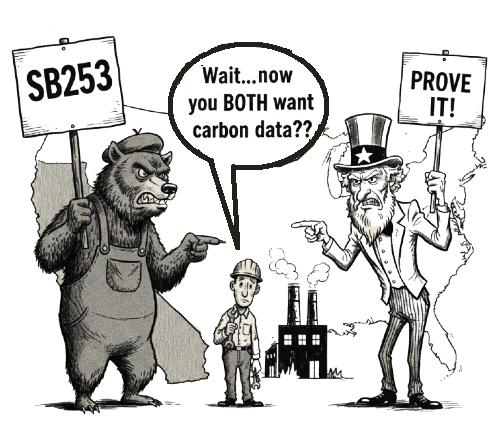
If you’re a US manufacturer who breathed a sigh of relief over federal climate rollbacks, you’re currently standing in the centre of a strategic pincer movement — and you may not have noticed yet.
While the “hardware” of international climate treaties is being dismantled in Washington, the “software” of global economic reality is tightening its grip from two directions at once. One jaw is closing from the left coast. The other from the capital itself.
The Left Jaw: California’s SB 253
The California Air Resources Board is moving forward with SB 253 — the Climate Corporate Data Accountability Act. Under this law, any company doing business in California with over $1 billion in annual revenue must publicly disclose their Scope 1, 2, and 3 emissions.
Here’s the supply chain implication that most manufacturers are missing: almost every major US enterprise — your customers — does business in California. That means their Sustainability Officers are now legally required to demand your emissions data. Not as a favour, not as a preference. As a condition of their own regulatory compliance.
Your Scope 3 numbers aren’t optional anymore. They’re your customers’ legal obligation to collect.
The Right Jaw: The PROVE IT Act
The Producing Responsible and Optimal Energy for Industry and Technology Act — the PROVE IT Act — has cleared the Senate with bipartisan support and been weaponised by the US Department of Energy as a trade instrument.
The logic is straightforward: the DOE is benchmarking the carbon intensity of US industrial production versus foreign competitors. The intent is to give US procurement officers a federal standard for preferring “competitively clean” domestic suppliers over high-risk foreign ones.
This isn’t a moral mandate. It’s a trade shield dressed up in sustainability language. Your Procurement customers won’t be selecting you because you’re virtuous — they’ll be selecting you because you’re defensible. And “defensible” now requires verified emissions data.
The Compliance side wants your data for the lawyers. The Competitiveness side wants your data for the sales team.
What This Means for Your Supply Chain
The era of “don’t ask, don’t tell” carbon accounting is over — not because the federal government mandated it, but because the market infrastructure around it has hardened in ways that can’t be rolled back by executive order.
The practical implications for manufacturers are sharp:
Your biggest customers are already exposed. If they operate in California, they need your numbers. If they can’t get them from you, they’ll find a supplier who can provide them — or they’ll estimate your footprint unfavourably and price in the risk.
The PROVE IT Act creates a new selection criterion. Federal procurement benchmarks don’t disappear when administrations change. The data infrastructure being built now will outlast the political cycle that created it.
Credible data is the new hard power. As I noted in my recent analysis of the 2026 SDG performance rankings: raw force is a terrible long-term investment. The compound interest of consistent, verifiable data beats the brute force of regulatory avoidance every time.
The rollback isn’t coming for the markets that matter. The question isn’t whether to prepare — it’s how quickly you can turn your emissions data from a liability into a competitive asset.
 Daniel Ross Perry